
Collar or harness – which is better for your dog?
For most dogs, a harness is a more comfortable and safer option for walks, especially if the dog pulls on the leash, is small, or has a short snout. The collar still has its place. It's lightweight, doesn't get in the way at home, and it's a good spot for an ID tag. That's why many owners use both: a lightweight collar with a tag for everyday wear and a harness when the leash comes out.
The difference in a nutshell
| Collar | Harness | |
|---|---|---|
| Where does the pressure land? | On the neck | Distributed across chest and shoulders |
| Dogs that pull | Less suitable | More suitable |
| Wearing all day | Lightweight and doesn't get in the way | Best to take off at home |
| ID tag and tracking device | Very convenient | Possible, but the harness is often not on the dog |
| Putting on the dog | Quick | Takes a bit longer |
| Control of the dog | Good on a calm dog | Good, and the dog can't slip out as easily |
When is a harness better?
When a dog pulls hard on the leash with a collar around the neck, all the weight falls on the neck and throat. A harness distributes the pressure over a larger area and is therefore better for the body. A harness is an especially good choice for:
- Dogs that pull. The harness won't solve the problem by itself, but it protects the neck while you practice walking on a loose leash.
- Small dogs. With small dogs, it takes little force for the pressure on the neck to become significant.
- Dogs with short snouts, like pugs and French bulldogs. For them, it's especially good to avoid pressure on the neck.
- Puppies who are learning to walk on a leash and jump and bounce in all directions.
- Dogs that tend to back out of their collar when they get startled.
If your dog coughs on walks, is sensitive in the neck or back, or you have other health concerns, you should talk to a vet about what equipment is best suited.
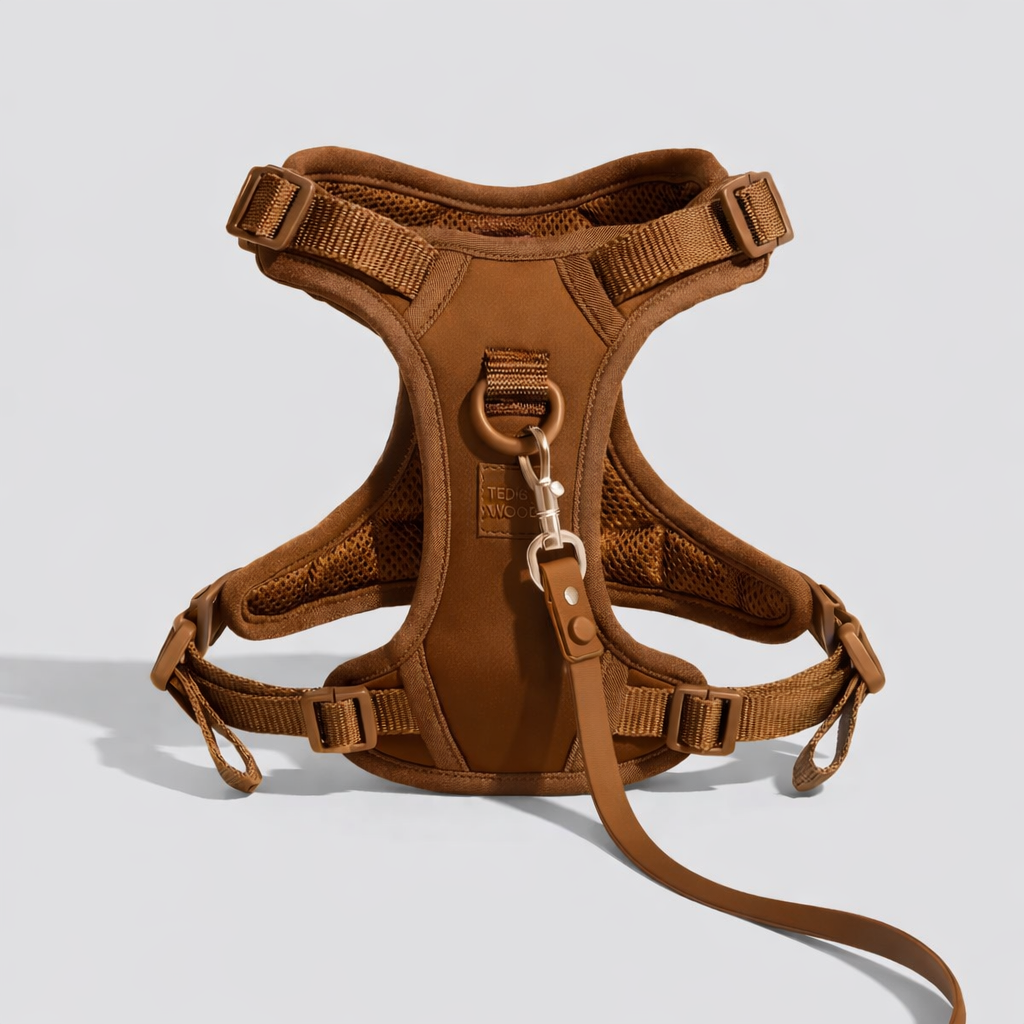
If you're looking for a soft harness for daily walks, the COMFORT harness from Ted & Wood is a good example. It's lightweight and padded, stretchy and durable, so it's gentle on the dog. You'll find more types in the collection Dog Harnesses.
When is a collar enough?
A collar is perfectly fine for a dog that walks calmly on a leash and pulls little. It's also the simplest way to have a tag on the dog around the clock, since the harness is usually taken off when you get home.
If you want the collar to be beautiful too, leather collars are a good choice. The Tiergarten leather collar is made of nubuck leather in deep green with a gilded brass buckle. The Central Park leather collar from Cloud7 is handmade from soft but durable, oil-tanned leather with gilded metal parts. You can see the full selection in the collection Dog Collars.
Take the collar and harness off the dog when it's in a crate or playing roughly with other dogs, as the equipment can get caught on something.
How should the equipment fit?
Collar
- Measure the neck circumference with a soft measuring tape where the collar should sit.
- You should be able to slip two fingers under the collar.
- The collar must not be able to slip over the head when you gently pull it forward.
Harness
- Measure the chest circumference at the widest point, just behind the front legs.
- Harnesses that form a Y on the chest along the breastbone usually allow the shoulders to move freely. A straight strap across the chest can restrict the stride in some dogs.
- Two fingers should fit under each strap.
- The straps must not lie tight against the front legs on the inside. Check the dog after the first walks and see if the harness rubbed the fur or if redness is visible on the skin.
If the dog is between sizes, it's best to try it on. You can also stop by our store at Nýbýlavegur 10 in Kópavogur and check out the selection.
Common mistakes
- Too loose a collar. A dog that reacts can back out of it in an instant.
- Too tight equipment. It causes chafing and discomfort, especially on long walks.
- Forgetting to readjust. Puppies grow quickly and the coat often thickens in winter and thins in spring. Check the fit regularly.
- Overlooking wear and tear. Check buckles, stitching and leash attachments every now and then and replace if anything is starting to give.
- Attaching the leash to the collar on a dog that pulls a lot when a harness would be a better choice.
The leash also matters. A leash that's too short encourages pulling, while one that's too long can get tangled. In the collection Leashes you'll find a selection of leashes.
ID tags and safety in the dark season
Whether you choose a collar or harness, your dog should always wear an ID tag with a phone number. Our ID tags are made of steel, available in three colors and two sizes, and can be attached to both collars and harnesses.
Many dog owners also attach an AirTag to the collar. The waterproof AirTag case is made of silicone and comes with two rings that are easy to thread onto the collar. The silicone case for smaller collars works best for thin collars, for example on small dogs. Neither case includes an AirTag. More solutions can be found in the collection Airtag for dogs.
Now that it gets dark early, it's also good for your dog to be clearly visible on evening walks. In the collection Safety you'll find products that help with that.
In short
A harness is better for dogs that pull, small dogs, dogs with short snouts, and puppies learning to walk on a leash. A collar suits calm dogs well and is the best place for an ID tag and tracking device. For many dogs, the best solution is to have both: a lightweight collar that the dog always wears and a well-fitted harness for walks. Whatever you choose, the equipment should fit well and you should check the fit regularly.